Animal of the Month: California Tortoiseshell Butterfly

You may have noticed the ground around Bend has been covered in a sea of orange and black over the past few weeks. Maybe you've had to wash your windshield more frequently, or maybe you've been dodging these flying beauties while out on a trail. Well, the reason for this explosion of orange and black also happens to be our animal (or rather, insect) of the month: the California Tortoiseshell Butterfly. 
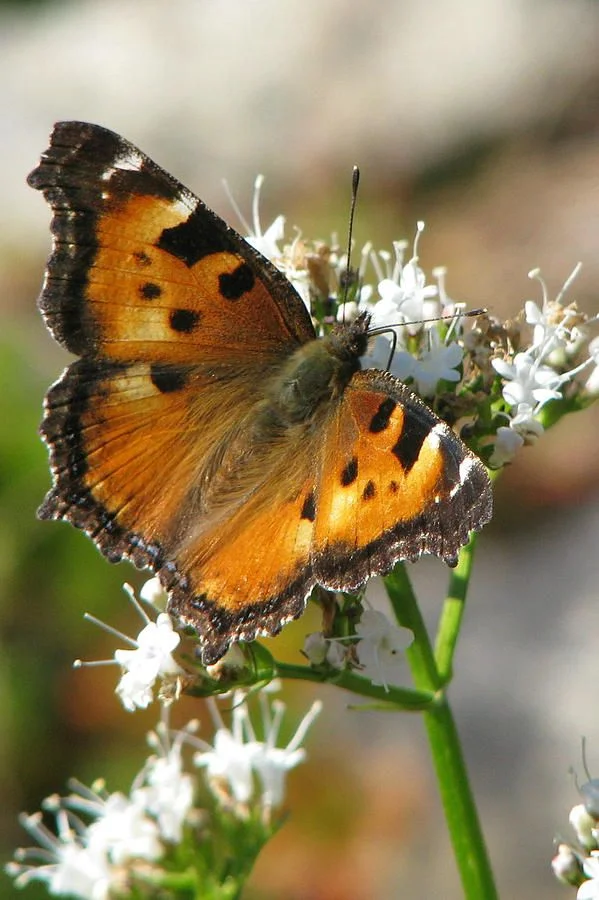
Photo courtesy of Frank Townsley, FineArtAmerica.com

Photo courtesy of Frank Townsley, FineArtAmerica.com

The Nymphalis californica, or California Tortoiseshell, was first identified by entomologist Jean Baptiste Boisduval in 1852. The top side of the wings are orange-brown with large black spots and dark wing borders. The underside of the wings are dark mottled brown with darker wing bases. This coloring serves as camouflage for the butterflies - when the wings are closed the butterfly looks like a dead leaf. Their wingspan measures between 3.2 and 7 cm. 

The "Tortie" overwinters as an adult and on mild midwinter days, can be found enjoying the sunshine outside of their overwinter location. Adults emerge in late May to early June and emigrate soon after, going north or east to higher elevation. This species is known for having population explosions. They are currently making their way through Oregon and the PNW, which explains why we're seeing such an abundance as of late! 

The cause of these population explosions is not as random as one might think. Entomologist and UC Davis Professor Arthur M. Shapiro, Ph. D., explains the reason for the California Tortoiseshell's massive population boom: 

"Occasionally the upslope movement encounters the retreating snowline, forcing females to lay only on Ceanothus that have melted out. This can result in enormous larval densities, total defoliation of the hosts and mass starvation -- while close at hand, plants that were still under snow when the eggs were laid sit absolutely untouched!" 

The range of the Tortie remains mostly on the west coast of the United States. From British Columbia south along the Pacific Coast to Baja California Norte, east to Montana, Wyoming, Colorado, and New Mexico. Rare migrants to Michigan, Pennsylvania, New York, and Vermont after periodic population explosions in Mexico.

California Tortoiseshell Habitat

Various species of wild lilac (Ceanothus) provide habitat for the butterflies to lay eggs, and food for caterpillars. Adults visit flowers of many kinds, aphid and scale honeydew, damaged fruit, sap. A particular favorite of the California Tortoiseshell is a mud puddle. The insects enjoy the damp surface, and it is possible to see hundreds or even thousands packed side-by-side enjoying the mud.

If you thought this year's population explosion was bad, just wait for next year! Following wildfires, buried Ceanothus seeds germinate and surviving Ceanothus resprout profusely, growing more rapidly than young conifer seedlings. This means we will likely be seeing a lot more of these guys next summer!

2017 Deschutes River Clean-Up

This Saturday, Wanderlust Tours joined some of Bend's most committed environmental stewards at the 2017 Deschutes River Cleanup along Riverbend Park! The Upper Deschutes Watershed Council (UDWC) teamed up with the City of Bend, REI of Bend, Bend Parks and Recreation District, Tumalo Creek Kayak and Canoe, Bend Paddle Trail Alliance, and Central Oregon Divers for a day of learning and taking action to clean up the Deschutes River as it runs through the Old Mill District. We walked, paddled, floated, and swam our way to a cleaner river! 

A patio chair and two wasted pipes were recovered from the bottom of the river.

A patio chair and two wasted pipes were recovered from the bottom of the river.

Using the three tenets of the UDWC, we connected with our Central Oregon community to educate locals in forging a life-long commitment to protecting and restoring the 2-million acre Upper Deschutes Watershed. The day began with a lecture in stewardship from the UDWC and its affiliates. Groups of volunteers split up based upon their preferred method of travel: paddle boarders, kayakers, rafters, and scuba divers headed to the river launch while dry-land volunteers spread across the edges of the river toting trash bags and rubbish grabbers. While the debris collectors hunted down and plucked harmful waste from the river, another portion of volunteers focused on the removal of invasive weed species. All efforts are necessary to ensure a happy and healthy Deschutes River! 

Below are a few unfortunate facts (and positive solutions!) we learned during the cleanup event that we think everyone should know!

•   Fact: Cigarette butt litter is the #1 most prevalent form of litter on Earth, accounting for 1/3 to 1/2 of all litter, and  adding up to 176,000,000lbs each year in the US alone. Careless disposal of cigarette butts and smoking material is the #1 cause of fires in Bend, and accounts for an average of $170,000 of our tax dollars every year to remedy. 
•   Solution: Dispose of smoking material into a non-combustible (metal or clay) container filled with sand and water to help extinguish the material. Make these receptacles easily accessible and abundant in numbers to remind smokers to dispose of their butts correctly.

•   Fact: Improperly secured or poorly functioning gear is one of the leading causes of litter and contamination in and along the Deschutes River. Pieces of foam, goggles, plastic, buoys, paddles, etc. all sink to the bottom or get caught along the edges of the river, contributing to the external litter sources.
•   Solution: Before you head out for a day of adventure and recreation, make sure to check all of your gear for safety, performance, and durability. Mend any impairments and secure any loose objects to your vessel. If an accident occurs and a piece of your gear goes missing, hunt it down and dispose of it properly!

•   Fact: Three common invasive species are detrimental to the health of the flora and fauna along the river. Spotted Knapweed (Centaurea maculosa) is an aggressive species that outcompetes native plants, causing soil erosion, surface runoff, and stream sedimentation. Common Mullein (Verbascum thapsis) houses many insects and toxic compounds that are harmful to other plans and fish. Dalmation Toadflax (Linaria dalmatica) is difficult to manage due to its deep and extensive root system and heavy seed production. Its colonies can push out native species, altering the composition of natural communities. 
•   Solution: Remove it! Using a pair of gloves and a shovel, gently tug repeatedly on the base of the plants until the root system has released its hold from the ground. Be sure to pick up any loose seeds and buds to keep the plants from manifesting in future seasons.

Invasive Species in the Deschutes River

We all have to do our part to #enjoyprotectrespect the Deschutes River. Bendites must hold each other accountable and lead by example when it comes to preserving our beloved corner of the Pacific Northwest. When we host visitors, we should go the extra step to make sure those we invite to town understand the Bend way. And when the rude people do show up, exercise patience and do little things to help. Start carrying an extra baggy on your hikes and walks to practice leave no trace. Educate our friends, neighbors and especially our kiddos on habitat restoration and environmental preservation. And finally, let's ignite that sense of community that is so strong in Bend to continue hosting awesome stewardship events like the UDWC Deschutes River Cleanup! 

A Guide to Hiking Tumalo Mountain

Here in Bend, we're pretty spoiled when it comes to opportunities for outdoor recreation. Situated perfectly at the base of the East Cascades, just north of Crater Lake and east of the Oregon Badlands Wilderness, Bend truly is an adventure playground. And with so many options at our fingertips, it can be difficult to decide how to spend your playtime! That's why we'll be bringing you a guide to outdoor activities that range in difficulty, time, and type of recreation. This week we're starting with a quick hike that is short in time but offers a high reward of views: Tumalo Mountain. 

An easy 21-mi drive west of Bend via the Cascade Lakes Highway, Tumalo Mountain is accessible year-round. An ideal snowshoe excursion in winter turns to a short but steep hike in the summer. The spectacular views are available year-round on a clear day: the Three Sisters and Broken top to the west, Mt. Bachelor and Mt. Thielson to the south, and Paulina Peak and Newberry Crater to the east. Getting to the trailhead is easy: follow the CLH due west until you see Mt. Bachelor on your left. The entrance to the Dutchman Flat parking lot will be on your right, and the trailhead is at the west end of the lot. Parking requires either an annual Northwest Forest Pass or a $5 day-use pass in the summer. 

Vital Statistics:
•  Distance: 3.9mi
•  Trail Type: Out-and-back
•  Tumalo Mountain elevation: 7,779'
•  Elevation Gain: 1429'
•  Average Hike Time: 1.5 hours
•  Gear Required: None
•  Kid friendly
•  Dog friendly


Trail description: 
This hike is relatively short but surprisingly steep, especially in the first 1/2 mile where you'll run into 5 switchbacks. Making your way through the Hemlock and Pine forest, you'll see gorgeous greens overhead. Once you're past the switchbacks, you'll come to a meadow that is home to a vibrant array of Lupine, Indian paintbrush, and other wildflowers at your feet. Hike another mile up the trail and you'll come to the last stretch of trail, which is lined in red volcanic rocks to keep hikers on-trail and off the fragile ecosystem underfoot. At the top of the summit, enjoy sweeping vistas of the surrounding Cascades and Badlands. 

Whether you're heading out to hike this fun and fast trail to catch sunset in the evening after work, or taking a leisurely stroll up the summit on a weekend, this hike is sure to please even the most experienced adventurer!